

Mission
The ECOFLEX-project, where nine Belgian partners collaborate, aims to unlock the potential of electric cars and energy communities to balance the grid in a climate neutral way.
Objectives
- Development of intelligent energy management algorithms which can determine optimal setpoints for various controllable assets taking into account the behavioural uncertainty and variety of customer and community requirements
- Determine value propositions which will convince consumers to engage their asset(s) in flexibility services of the energy market
- Investigation of new market models (in contrast to the current central design of/and access rules) for the energy (flexibility) market and definition of the roles of stakeholders
- Demonstration of an user-centered and interoperable ecosystem with a level playing field for companies to enter a profitable supply chain for flexibility services


 |  |  |
 |  |  |
 |  |

Green Energy Park
The Vrije Universiteit Brussel (VUB) and the Universitair Ziekenhuis Brussel (UZ Brussel) have set up the non-profit organisation Green Energy Park, with the aim of facilitating research. Among other things, it is developing a large living lab where companies, research institutes and governments work together in co-creation on solutions to societal challenges related to energy and mobility.
The living lab will include a large-scale, innovative electric grid, an ultra-low-temperature heat grid and extensive electric mobility facilities for research purposes. The data centre will valorise its waste heat by connecting it into a strict heating network to serve other buildings on the campus.
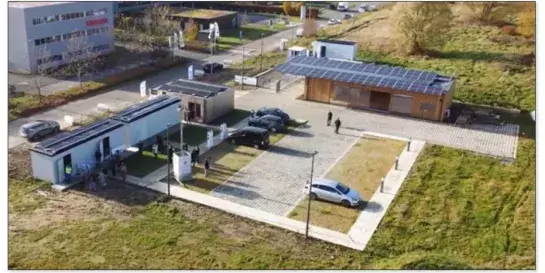
smart village lab
In anticipation of Green Energy Park's large-scale living lab, a smaller-scaled living lab has already been built, capable of accommodating initial research needs. This living lab, the Smart Village Lab, Lab consists of a smart distribution cabin, an EV charging plaza, a Control Centre, community batteries and the Smart Home Lab.
The Smart Village Lab was realised by Flux50 and Green Energy Park, through 2 projects: Interreg NWE RegEnergy and ERDF SMEL-1.
Smart home in a smart residential area
The Smart Home Lab consists of 6 ´flexible´ homes that will be used mainly for the development of intelligent systems that allow a home to be controlled smartly and sustainably. The homes will exchange electrical and thermal energy among themselves via a "Smart Energy Grid", an energy network to which collective energy systems such as community batteries and collective charging infrastructure for electric cars are also connected.
Each of the 'flexible homes' includes a typical residential electrical installation with its digital meter, distribution board and PV system. These can also be extended with home energy management systems, home batteries and charging stations.
In terms of electrical consumers, there is a combination of real devices and simulated devices. The simulated appliances are 'controllable consumers', consumers that can play back the real (pre-measured) load profile of the appliance (via controllable dimmers), so that the power profile on the electrical board closely resembles that of a home with real appliances.
Research, development, training and demonstration
For example, you can link solar panels to the car or a home battery, to washing machines or to heating. With the advent of a capacity tariff and the opportunity of maximum self-consumption, it will become important to spread electricity use (peak monitoring) or steer in function of the sun. Smart control is then a possible solution.
Testing such steering is an example of a project that can make use of the lab infrastructure.
The Smart Home Lab can be used for innovation, testing, demonstration as well as training.
The living lab supports Flemish and European research and development projects. Within these projects, new technologies can immediately be tested and further refined in a real environment, which greatly enhances the quality of these projects. Companies that want to test or demonstrate an integration with (community) batteries are also welcome. The living lab is also used for education and training and can be visited by schools and the general public. Thus, everyone can get acquainted with these innovations and their importance in the societal energy transition.
Contact
- Address : Z1 Researchpark 160, Zellik, Vlaanderen 1731, BE
- Email : evergi@vub.be
- Website : https://www.greenenergypark.be
Negundo district
The NEGUNDO district is located at the back of the TOURNAI-WEST I economic activity park, along the highway. The district currently has business, training and innovation centers as well as relay halls and a kindergarden. The site is also equiped with its own set of energy infrastructure.
As owner of the site, IDETA (the Regional Development Agency of Piccardy Wallonia) has included the site in the e-Cloud (2019-2020) and HospiGREEN (2020-2023) energy-related pilot projects. These projects shared locally produced solar and wind energy collectively within the projects' renewable energy communities. The site is therefore experienced in collective self-consumption of renewable electricity.
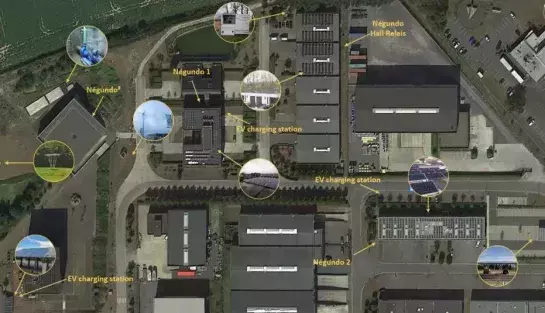
Négundo 1
→ 2 000 m² of offices and meeting rooms
→ Air/water heat pumps of 230 kW
→ HVAC (heating, ventilation, and air conditioning) module of 8 330 m³/h
→ Charging stations 3 x 22kW and 1 x 11kW
→ 103 PV solar panels 25,72 kWp
→ Micro turbine-pumping power plant (Pump as Turbine) 17 kWh
Negundo 2
→ 282 PV solar panels 68,4 kWp (on roof : 47,6 kWp and on carport : 20,8 kWp)
Négundo 3
→ Spaces for seminars, meetings and offices
→ Classrooms
→ Ground/water heat pump 60 kW
→ 2 HVAC modules of 12 300 and 9 000 m³/h
→ 4 small wind turbines 2,4 kW
→ Solar Flower Shadehouse with 12 PV solar panels 4,2 kWp
→ 49 PV solar panels 9,8 kWp on roof
Negundo Relay Halls
→ 160 PV solar panels 48 kWp on roof
→ 1 Vanadium-redox-flow battery with a capacity of 100 kWh, nominal power of 10 kW
→ Further battery sollution to be deployed for the project

WP1 – Project management & dissemination
- D1.1 Workshops with advisory board
- D1.2 Report of the 1st Advisory Board meeting
- D1.3 Report on the Advisory Board (AB) meeting 2
- D1.4 Report on the Advisory Board (AB) meeting 3
- D1.5 Report on ECOFLEX website
- Project Handbook
WP2 – User centric, robust design of flexibly ecosystem
- D2.1 Market scheme
- D2.2 Data system architecture
- D2.3 Market and Flexibility Forecast Algorithms
- D2.4 Guidelines and Testing Framework for Energy Management Service Providers
- D2.5 Case of EMS Service Provider
WP3 – Common system development
- D3.1 Specification kit for ledger
- D3.2 Generic Energy Management System Interface
- D3.3 Integration Access Register
WP4 – Energy Management services for E-mobility
- D4.1 Smart Charging Management
- D4.2 Front end applications for charge scheduling
- D4.3 Digital twin model of public distribution network predicting maximum hosting capacity
WP5
- D5.1 Report on Multi‑Energy Flexibility Markets
- D5.2 Multi‑energy community energy management
- D5.3 Power quality and local network model
WP6
- D6.1 Implementation of flexibility ecosystem
- D6.3.1 Determination of the optimal voltage level from efficiency aspect
- D6.3.2 Design rules of a DC backbone as a function of the available RES, envisaged loads infrastructure and flexibility
- D6.4 Analysis of feasibility of the developed solutions at UGent Testfield
WP7 – Flexibility Market Analysis
- D7.1 Stakeholder feedback analysis
- D7.2.1 Life Cycle Assessment Data Provision
- D7.2.2 Report on the Sustainability impact
- D7.3 Replicability and feasibility of the massive roll‑out of ECOFLEX solutions
- D7.4 Report on the Legal Context of the New Market Model
Publications
List of Publications from the ECOFLEX project
Year | Type |
| Reference | Link/doi |
2023 | Conference | ISGT Europe | Cleenwerck, R., Parys, W., Putratama, M.A., Desmet, J. and Coosemans, T., 2023, October. Smart Meter-Based Re-Phasing for Voltage Imbalance Enhancement Through Topology Reconstruction. In 2023 IEEE PES Innovative Smart Grid Technologies Europe (ISGT EUROPE) (pp. 1-5). IEEE. | |
2023 | Conference | ISGT Europe | Putratama, M.A., Cleenwerck, R., Desmet, J., Messagie, M. and Coosemans, T., 2023, October. Flexibility Valorization in Energy Communities: Grid Constraints Impact and Mitigation. In 2023 IEEE PES Innovative Smart Grid Technologies Europe (ISGT EUROPE) (pp. 1-5). IEEE. | |
2024 | Conference | SETAC Europe | Huber, D., Philippot, M.L., Felice, A., Putratama, M.A., Coosemans, T. and Messagie, M., 2024, May. Life cycle assessment of future energy system flexibility–a methodological framework applied to Belgium. In SETAC Europe 34th Annual Meeting. | |
2024 | Journal | Energy and AI | Ruddick, J., Ceusters, G., Van Kriekinge, G., Genov, E., De Cauwer, C., Coosemans, T. and Messagie, M., 2024. Real-world validation of safe reinforcement learning, model predictive control and decision tree-based home energy management systems. Energy and AI, 18, p.100448. | |
2025 | Journal | Knowledge-Based Systems | Ruddick, J., Camargo, L.R., Putratama, M.A., Messagie, M. and Coosemans, T., 2025. TreeC: a method to generate interpretable energy management systems using a metaheuristic algorithm. Knowledge-Based Systems, 309, p.112756. | |
2025 | Conference | CIRED | Cleenwerck, R., Ruddick, J., Van Kriekinge, G., Naghdizadegan Jahromi, S., Putratama, M. A., Coosemans, T., Desmet, J., 2025. “ECOFLEX Project: Leveraging Flexibility From Low-voltage Assets”. In 28th International Conference on Electricity Distribution (CIRED 2025) (pp. 1-5). | 10.1049/icp.2025.1812 |
2025 | Conference | EVS | Naghdizadegan Jahromi, S., Van Kriekinge, G., De Cauwer, C. and Coosemans, T., 2025, June. Scheduling Electric Vehicle Charging for Participation in the Belgian Imbalance Market Using Model-Free Reinforcement Learning. In The 38th International Electric Vehicle Symposium & Exposition (pp. 1-12). EVS38. | https://www.researchportal.be/en/publication/scheduling-electric-vehicle-charging-participation-belgian-imbalance-market-using-model |
2025 | Journal | Journal of Energy & Natural Resources Law | Chen, T. and Vandendriessche, F., 2025. Legal issues of developing local electricity markets: energy communities as an example. Journal of Energy & Natural Resources Law, pp.1-28. | |
2025 | Preprint | N/A | Cleenwerck, R., Claeys, R., Coosemans, T. and Desmet, J., 2025. The Low-Carbon Transition in European LV Distribution Networks: A Questionnaire-based survey on Power Quality and Digitalisation. | |
2025 | Preprint | N/A | Huber, D., Van Den Oever, A., Lavigne Philippot, M., Coosemans, T. and Messagie, M., Flexibility Services of Battery Electric Vehicles: A New Assessment Methodology Considering Different Scales. |